| Quoted from SEDS
Discovered by Edmond Halley in 1714.
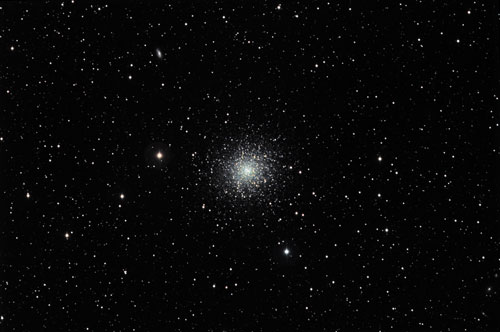
Messier 13 (M13, NGC 6205), also called the 'Great globular cluster
in Hercules', is one of the most prominent and best known globulars of
the Northern celestial hemisphere.
It was discovered by
Edmond
Halley in 1714, who noted that 'it shows itself to the naked eye
when the sky is serene and the Moon absent.' According to
Charles
Messier, who
cataloged it on June 1, 1764, it is also reported in
John Bevis'
"English" Celestial Atlas.
At its distance of 25,100 light years, its angular diameter of 20'
corresponds to a linear 145 light years - visually, it is perhaps 13'
large. It contains several 100,000 stars; Timothy Ferris in his book
Galaxies even says "more than a million". Towards its center, stars
are about 500 times more concentrated than in the solar neighborhood.
The age of M13 has been determined by Sandage as 24 billion years and by
Arp as 17 billion years around 1960; Arp later (in 1962) revised his
value to 14 billion years (taken from Kenneth Glyn Jones).
According to Kenneth Glyn Jones, M13 is peculiar in containing one
young blue star, Barnard No. 29, of spectral type B2. The membership of
this star was confirmed by radial velocity measurement, and is strange
for such an old cluster - apparently it is a captured field star.
Observers note 4 apparently star-poor regions in M13 (e.g., Mallas).
Suggestions of them can be noted in some photos.
Globular cluster M13 was selected in 1974 as target for
one of the
first radio messages addressed to possible extra-terrestrial
intelligent races, and sent by the big radio telescope of the Arecibo
Observatory.
Nearby, about 40 arc minutes north-east of M13, is the faint (mag 11)
galaxy NGC 6207, visible in many large- and medium-size-field
photographs of M13, e.g., in the
DSSM image. This
galaxy has recently produced a type II supernova (SN 2004A).
|